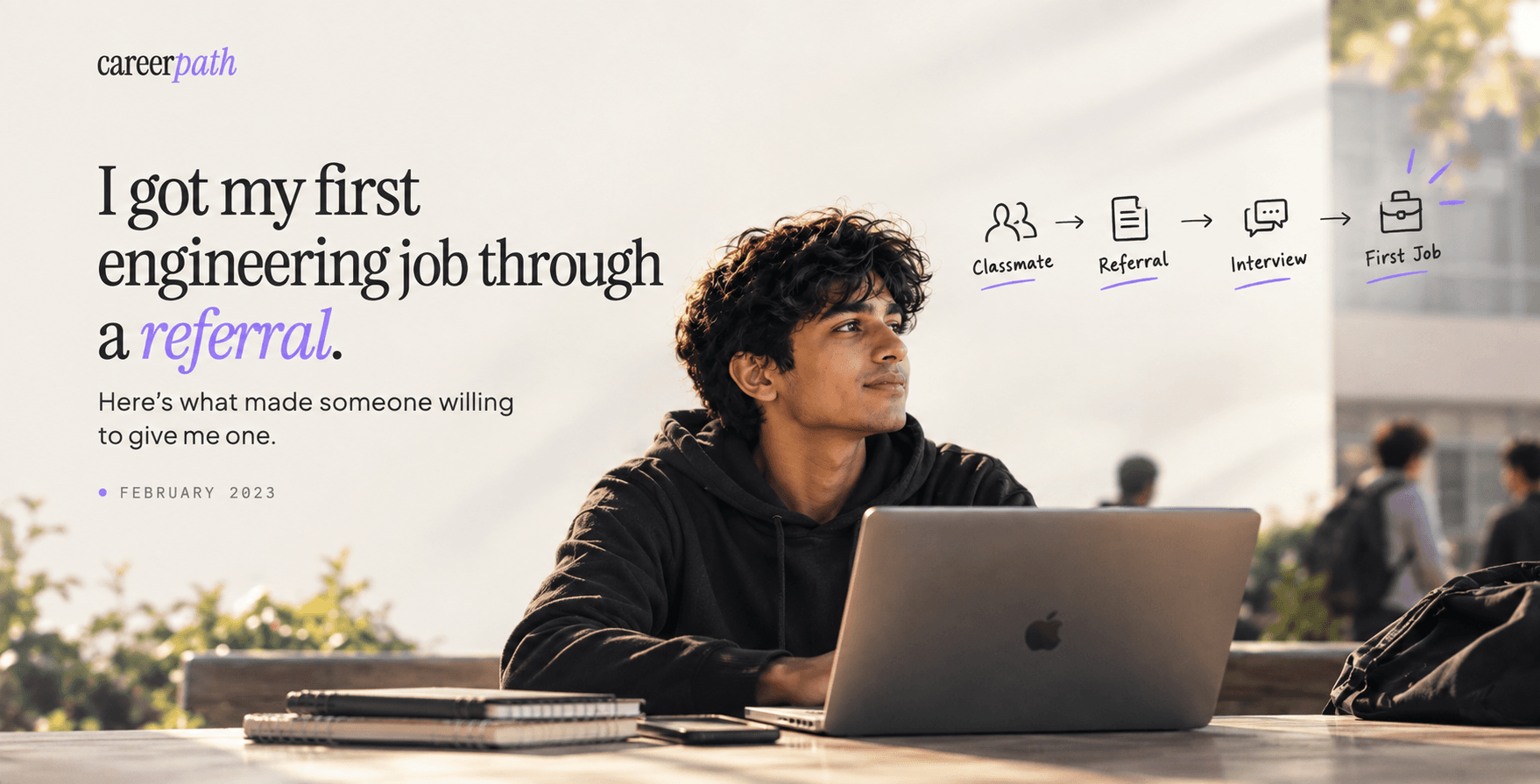
In February 2023, in my fourth semester, I got my first paying engineering job. I did not apply for it. A classmate put my name forward.
I want to start there, because most posts like this skip it. You read about the resume, the projects, the interview prep, and somewhere underneath it all is a referral nobody mentions. Then you follow the advice, it does not work, and you assume something is wrong with you.
So: a referral got me in the room. Nothing else about it was luck, and the referral did not get me the job.
Why a classmate put his name on a second-year student
He had seen my projects.
Not impressive ones. A Splitwise clone. A burger builder app. A portfolio site. The kind of thing people build in third year because a course told them to. Mine were not better than anyone else's.
The difference was that people had seen them. I talked about frontend work. I built things and showed them around. So when a role came up and someone asked my classmate whether he knew anyone, I was the name that surfaced. Not because I was the best engineer he knew, but because I was the one he could picture doing the work.
That is the whole mechanism, and it is duller than "networking". Nobody refers you because you attended an event. They refer you because putting your name forward costs them something, and they have seen enough of you to think it is a safe bet.
What the referral actually bought me
One conversation.
That is it.
The interview itself was relaxed. More of a conversation than an interrogation, which surprised me at the time, and which I now think is far more common than students expect, especially at smaller companies. Nobody was trying to catch me out.
But relaxed is not the same as a formality. They asked real questions and I had to actually know the answers.
I had claimed React on the strength of those clones, so they asked me about React. Hooks, mostly. What the rules are, when effects run, why you cannot call one conditionally. What made that easy was that at some point I had read the React documentation properly, end to end, rather than skimming it for the snippet that would make an error go away. I understood why things behaved the way they did.
That is a boring advantage and it is available to anyone. The documentation is free. Most people never read it.
The other half was that I could talk about my own work clearly. I had explained those projects to people before, so explaining them to a stranger was not a new skill. If you have never described your own code out loud to another human, an interview is a bad place to try it for the first time.
What the job was actually like
I started on bugs. This was before coding agents, so finding a bug meant reading code until you found it. Opening files, following the trail, building a picture of a codebase nobody had explained to me.
I liked it more than I expected. Locating a bug in somebody else's code teaches you how software is actually put together, which building your own toy projects does not. And I was fast, and I delivered when I said I would, which turned out to matter more than being clever.
From bugs I moved on to whole modules. Eventually I built the main landing page for the brand, which I showed to more people than was strictly reasonable.
None of that came from the referral. The referral ended the moment I walked into the interview.
What I would tell a second-year with no network
Be useful to the people already around you.
Not "network". You do not have a network at nineteen and you are not going to build one at a conference. What you have is a class full of people who will, within two years, be working at companies that are hiring. Some of them will be asked whether they know anyone.
Be the person they can picture doing the work. That means building things where people can see them, talking about what you are learning, and being someone whose name is safe to say out loud.
Then be ready, because the referral only buys you the conversation. Read the documentation for whatever you claim to know. Practise explaining your own work to another person. The reference opens the door and then it is gone.
One caveat on all of this. It assumes you already know roughly what you are aiming at. I did, because I had settled on frontend before any of this happened, and that is what made the projects worth building in the first place. If you are earlier than that and still deciding, the career quiz is somewhere to start. It is a starting point rather than a verdict, and it is free.

Machine Learning Engineer · Revcloud
I'm a machine learning engineer at Revcloud. I build the ML systems that serve about 50,000 people a day, plus the AWS and Azure infrastructure they run on. I finished my computer science degree at COMSATS in 2025, but I'd already been working as an engineer since my second year. I've also sat on the other side of the interview table for around twenty candidates in backend, AI and web roles. Most of what I write here comes out of that.